
Karate for fitness, focus and a calm mind in Doha
A full-body workout and moving meditation in one class. Traditional Japanese karate builds strength, flexibility, posture and stamina, and trains breathing, focus and calm under pressure.
A workout with a purpose
Treadmills and machines train your body. Karate trains your body and your mind together. Every class has a mobility warm-up, low stances that build the legs and core, fast combinations for cardio, kicks for flexibility and kata that demand full concentration.
You finish tired, calm and a little more skilled than when you started, with a belt goal to work towards. That is why karate students keep training for years.
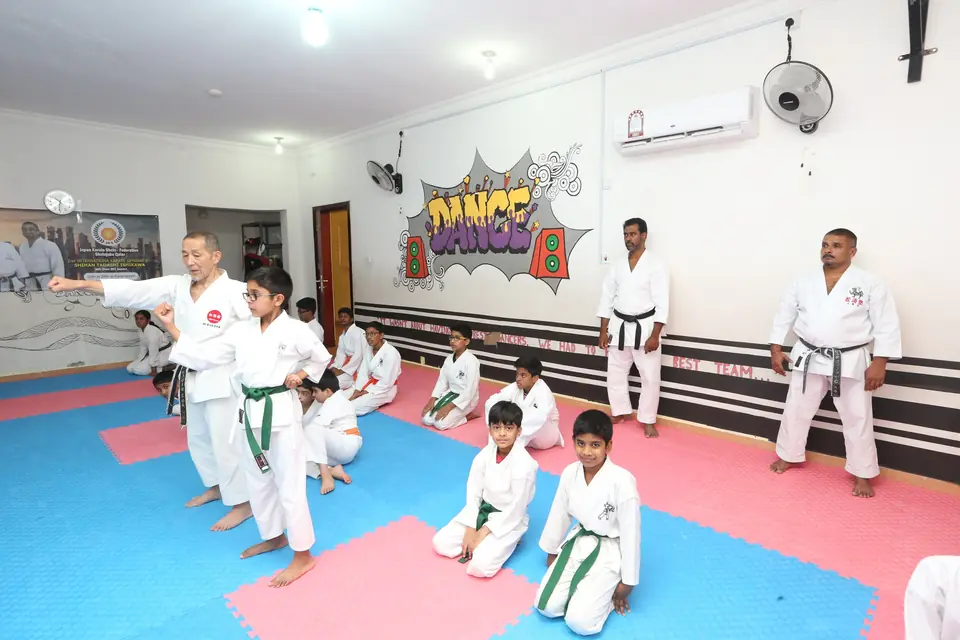
What karate does for body and mind
The benefits students notice.
Strength and stamina
Stances, combinations and partner drills build leg, core and upper-body strength and cardiovascular fitness.
Flexibility and posture
Kicks and stretching open the hips and hamstrings; stances and kata train an upright, balanced posture.
Balance and reactions
Footwork and partner drills sharpen coordination, reaction speed and single-leg balance.
Focus
Learning kata and new techniques demands full attention, a break from screens and multitasking.
Breathing and calm
Mokuso meditation and deep breathing (ibuki) release tension and help you switch off after work.
Confidence
Every belt you earn proves you can set a goal and reach it, and self-defence skills help you feel safe.
Strong, not aggressive: the mental benefits of karate
Karate is a peaceful martial art. Its first rule is 空手に先手なし: there is no first attack in karate.
Some combat sports focus mainly on hitting and winning fights. Traditional Japanese karate builds power and the self-control to keep it in check. Children and adults become physically strong and mentally calm: confident enough to walk away, and capable enough to protect themselves if they ever must.
Self-control
Every technique stops exactly on target. Students learn to control their body, their temper and their reactions.
Calm under pressure
Breathing, kata and kumite teach the mind to stay steady when things get difficult, in exams, sport and daily life.
Confidence without arrogance
Real confidence is quiet. Karateka stand tall and speak up, without needing to prove themselves.
Respect and humility
Bowing to teachers, partners and the dojo teaches children to respect others, and to accept correction gracefully.
Focus and mindfulness
Every class opens and closes with mokuso, a moment of silent meditation that trains attention and a clear mind.
Resilience
Failing a technique, trying again and finally earning a belt teaches patience, perseverance and a growth mindset.
Our dojo kun, recited by every student, ends with “Refrain from violent behaviour.” Parents often tell us their child became calmer, more patient and kinder at home and at school after starting karate.
Questions people ask
Anything else? Message us on WhatsApp.
Is karate a good workout?
Yes. A karate class combines a mobility warm-up, stances that build the legs and core, fast combinations for cardio, kicks for flexibility and kata for coordination. It is a full-body workout with a skill at the end of it.
Can karate help with weight loss?
Karate burns energy and builds muscle, and many students lose weight alongside sensible eating. The bigger difference is that people enjoy it and keep coming, which is what makes any fitness plan work.
Is karate better than the gym?
They do different things. The gym builds muscle with fixed, repetitive movements. Karate trains strength, balance, rotation, flexibility and reaction speed together, adds a mental challenge, and gives you a self-defence skill and belt goals. Many people do both.
Can karate help with stress and mental focus?
Many students say it does. Full concentration on technique, deep breathing and kata (often called moving meditation) take your mind off work and screens. Karate is not a substitute for medical or psychological care, but it is a healthy, supportive way to look after your wellbeing.
Does karate improve posture?
Karate trains an upright, balanced posture in every stance and kata, and strengthens the core and back muscles that hold it. Students often notice they stand and sit taller.
Do you teach breathing and meditation?
Yes. Every class starts and ends with mokuso, a short seated meditation, and karate uses deep breathing such as ibuki. Sensei Najmal also teaches tai chi and qigong at thechiclub.org.
See also: adult karate and longevity, ladies-only karate, which martial art is best, and tai chi and qigong.
Your first class is free
Message us on WhatsApp and try a class this week. No experience, no uniform and no commitment needed.